

Why Standardization is the Foundation of High-Performing Precast Operations
Talk to enough precast operations leaders and one word keeps coming up: inconsistency. Not in the concrete itself, but in how work gets done. One crew completes a punch-list item in a certain way. Another crew, running the same line two shifts later, handles it differently. A plant three states away tracks quality control on paper while headquarters logs it in a digital system.
None of this shows up as a single crisis. It’s a slow drain: a little rework here, a missed deadline there, a client who mentions that their last precast project felt more organized than this one. By the time it’s visible on a P&L, it’s already been costing you for a year.
Here’s the thing worth sitting with: standardization doesn’t mean forcing every crew into a rigid checklist and eliminating the judgment that makes your best people good at their jobs. It means making sure that everyone on your team is using the same best practices. If your top-performing crew leader leaves tomorrow, would their processes go with them?
Where the Quality Gaps Actually Show Up
A few places this tends to happen if you go looking for it:
Crew to crew: Two crews on the same product line, trained by different people at different times, quietly develop their own shortcuts, especially around documentation and quality checks. Nobody decided this should happen. It just did.
Shift to shift: Day shift has a supervisor walking the floor constantly, but night shift might not, and issues get fixed quietly instead of logged. Neither approach is wrong on its own, but they produce two different pictures of what’s actually happening on your line.
Plant to plant: This is where things compound. One facility tracks punch-list items religiously in a shared system. Another uses a supervisor’s notebook and muscle memory. A customer working with both plants notices immediately, even if they can’t quite articulate why one felt smoother.
Project to project: Without a shared process for project documents like submittals and change orders, every project manager basically invents their own system. Then, when someone goes on leave, whoever covers for them has no idea where anything is or how to manage it.
Production to dispatch: The floor knows what’s been poured. QC knows what’s passed inspection. The yard knows where pieces are sitting. But if dispatch is building shipping plans based on different numbers, the result is a costly bottleneck.
Crew to crew
Undocumented shortcuts creep in
Shift to shift
Issues fixed, never logged
Plant to plant
Different systems, different results
Project to project
Every PM invents a process
Production to dispatch
No single source of truth
What This Actually Costs Your Precast Company
Rework that traces back to a rushed or skipped QC step. Punch-list items that get forgotten and turn into change orders, or worse, a callback after the project’s already closed out. Dispatch planning around production numbers that don’t quite match what’s happening on the floor. A new hire spending their first three months learning “how we do it here” instead of just learning the job.
None of this lands as a dramatic failure. It just quietly erodes margin and reputation, one small gap at a time, until someone finally asks why two plants get such different results.
What Good Precast Standardization Looks Like
Can your precast team answer a simple question: when something goes wrong with a project, can you trace it back to a specific step in the precast manufacturing process? Or does it just get chalked up to “mistakes happen, let’s fix it and move on”?
A punch-list item should get logged and tracked the same way whether it’s flagged in Michigan or Texas. A QC check should follow the same steps on the night shift as it does on the day shift. A change order should move through the same review path no matter which plant it came from. When a new project manager starts, they should be stepping into a process, not reverse-engineering one from remaining team members.
The Part Most Precast Manufacturers Miss: You Can’t Standardize What You Can’t See
Standardization problems in the precast concrete industry usually get treated as training problems. You run another workshop, put up another poster, or bring it up at the next shift meeting. But most of the time the real issue is visibility. If leadership can’t see how punch lists get handled from plant to plant, there’s no way to know where the gaps are, let alone close them.
Software matters here because it changes what’s easy. When the standardized way is also the fastest way to get the job logged and moving, people follow it. When it’s an extra step on top of the “real” work, it’s the first thing to go under deadline pressure.
How Concrete Vision Helps Close the Standardization Gaps
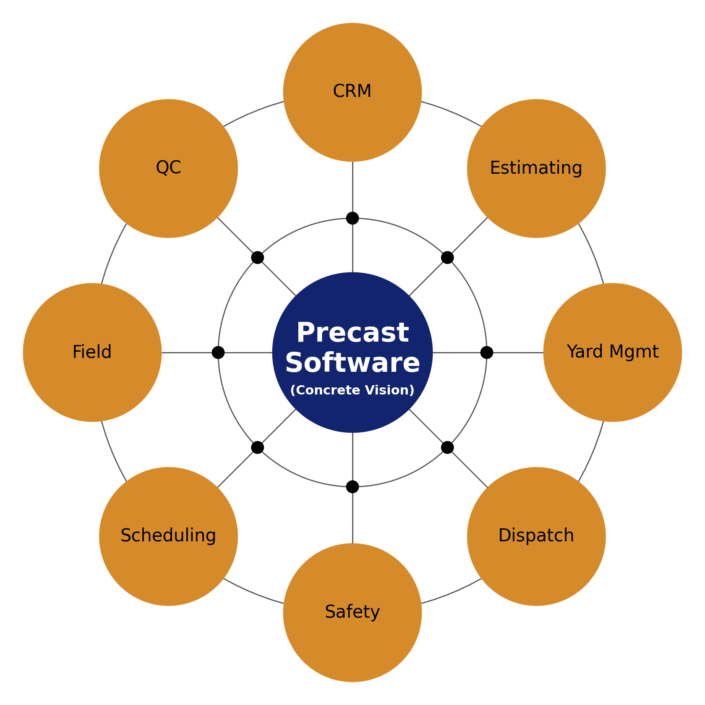
Concrete Vision is software built specifically for precast manufacturers. It’s a web-based system where sales, production, quality, dispatch, and project data all live together. Here’s how that plays out against each of the gaps above.
Crew to crew: one way to document the work. The Quality Control module gives every crew the same place to record checks, so documentation doesn’t depend on who trained whom. For producers using Idencia, the integration lets crews capture QC and yarding data on mobile devices, even where connectivity is spotty, and sync it back later.
Shift to shift: the record doesn’t clock out. Because production scheduling and quality data sit in the same system, night shift works from the same schedule and the same history as day shift. An issue that gets logged at 2 a.m. is still there for the supervisor at 7 a.m. Nobody has to rely on a hallway conversation to pass it along.
Plant to plant: same system, same standard. Every facility works in the same platform, so leadership can compare how plants are performing instead of guessing. In the Jobs module, punch-list items are tracked by job, job area, and responsible party. They can be opened, closed, and reopened as work moves forward. A punch list in Michigan looks exactly like a punch list in Texas.
Project to project: a process that doesn’t walk out the door. Submittals, transmittals, RFIs, change order requests, meeting agendas and minutes, project contact lists, and notes all live with the project record, along with phase tracking and percent completion. When a project manager goes on leave, whoever covers for them opens the project and sees exactly where things stand.
Production to dispatch: one set of numbers. When Dispatch and Yard Management work from the same production data the floor is using, shipping plans line up with what’s actually been poured, cured, and inspected.
Standardization Is a Rollout, Not Just a Login
New software doesn’t standardize anything by itself. How it gets rolled out matters just as much. Concrete Vision customers are assigned an implementation trainer who acts as a single point of contact through setup. Our consulting team can assist you with migrating data from your current system and connecting Concrete Vision to the tools you already use. Training for precast teams and administrators means every plant learns the system the same way, and technical support keeps it that way after go-live.
The result is a consistent process, not one each crew, shift, or plant pieces together on its own.
Where to Start with a Precast OMS
You’re not going to standardize your whole operation in a quarter, and trying usually burns people out. Pick the process causing the most visible pain right now, whether that’s punch lists, QC documentation, or the handoff between production and dispatch. Get that one process consistent and visible first. Once people see it working, the case for the next improvement makes itself.
The precast plants that consistently hit deadlines and protect their margins usually aren’t the ones with the most talented individual crews. They’re the ones where it doesn’t matter who’s on shift, because the standard is the same either way.
Want to see what that looks like in your precast operation? Schedule a demo and we’ll walk through how Concrete Vision can help standardize the process that’s costing you the most right now.